
When it comes to family farms, Tim Scarbrough’s credentials go back all the way to the founding fathers. “John Scarbrough was William Penn’s best man at his wedding,” Tim notes. “Penn gave him 250 acres of land north of Philadelphia and we’ve been farming since then.”
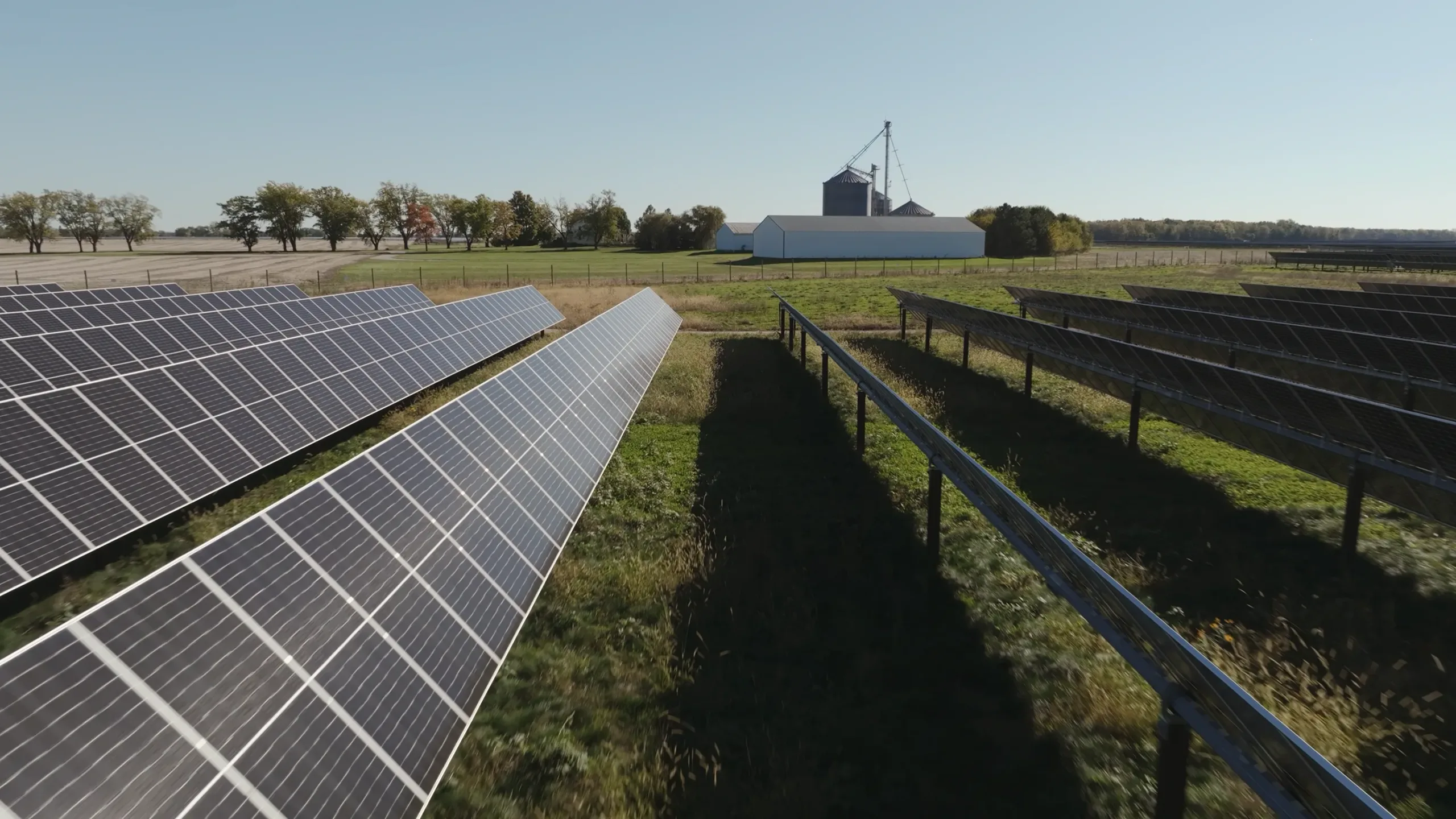
Today, Tim continues that legacy in Hardin County, Ohio, where he grows corn and soybeans on farmland he bought in 1988. He also leases part of that land for a solar project—an addition that some might see as a disruption to traditional agriculture. But for Tim, it’s a way to protect it.
“There’s a big misconception,” he said. “People think solar is destroying the ground. But on our project, no soil left the farm. It’s flat like it was before. And by the end of the lease, we’ll be bringing back land that’s been resting and growing organic matter. It’ll be in better shape than it was before”.
The contrast with other kinds of development is stark. “When you put in a housing development, that land’s gone forever,” Tim said. “You’ve got basements. You’ve disturbed it. You’re not going to bring that back”.
Instead of replacing agriculture, Tim sees solar as part of it. “We’re farming the sun,” he said. “Corn and beans are one way. Solar is just another way to farm”.
“We’re farming the sun… Corn and beans are one way. Solar is just another way to farm”
This approach has practical benefits too. “We’re in a drought year in Ohio,” he said. “Having some of your ground in solar helps you spread out your risk. It keeps farmers afloat in a bad year”.
Jeff Smith, a seventh-generation farmer in Snyder County, Pennsylvania, knows the pressures all too well. “This farm has been in my wife’s family for 200 years,” he said. “We’ve always believed in working the land. But that gets harder every year.” A few years ago, Jeff learned about a new farming opportunity, one that would pair well with his livestock operations. Jeff and his family now use part of their property for “solar grazing”, with flocks of sheep grazing the fields beneath solar panels. “Solar gave us a new income stream without giving up the land.” They’ve put solar panels on pastures covering a quarter of their land, expanding their revenue without disrupting the cattle herds they raise on the other farmland. “The panels even help the grass grow better,” he said. “It supports our livestock, adds income, and we don’t have to sell off land to make ends meet.”
And for others, like Caroline Owens, solar represents a second chance after development forced her out of her first farm in New Hampshire. “The woods next door went to a housing development, and suddenly our 13-acre farm was just too little,” she said. “We realized we needed to move to keep our way of life.” Now operating a sheep farm in Pennsylvania, solar grazing has helped to expand their operations 10-fold from their original farm. “it takes a lot of sheep to graze these sites, and…we’ve been increasing our flock in anticipation of having the right numbers. So sheep on solar is a very positive influence for the sheep industry in the state.”
The stakes are clear. When farmland is sold to build houses or big box stores, it’s gone forever. The soil is paved over, foundations are poured, and nothing will grow there again. That’s why farmers across the region are embracing solar not just as an economic lifeline, but as a strategy to keep land in the family, even long after they are gone.
“We’ve always been farm owners,” Tim emphasizes. “The most important part of my legacy will be for my kids to be able to hang on to the farm…you get so much more money from solar, the added income could help them pay inheritance taxes and still own the farmland.”
Solar won’t replace farming, but it can help preserve it. It gives families the financial cushion to say no to sprawl and yes to staying. And it puts the future of rural communities back in the hands of the people who built them.