
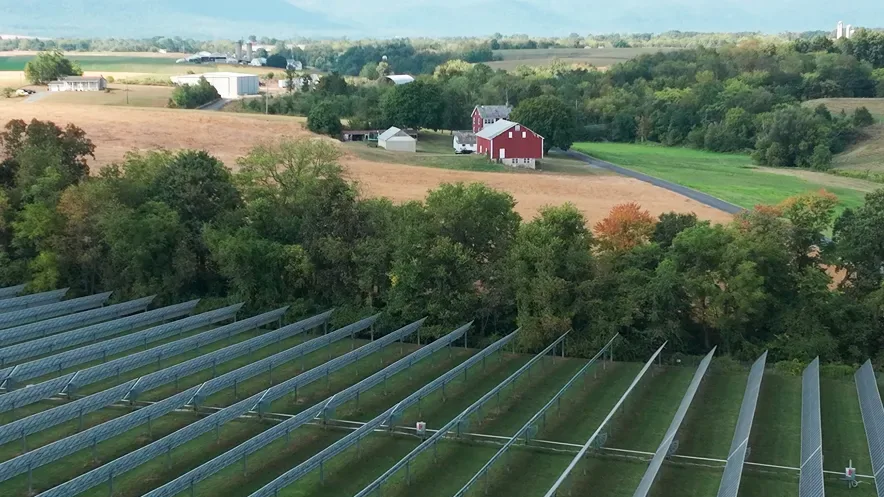
From a distance, utility-scale solar can look simple. Rows of panels stretching across open land.
But building modern energy infrastructure is highly technical work that demands precision, coordination, and rigorous safety standards.
Today’s utility-scale solar projects involve far more than installing panels. Workers must build and integrate high-voltage electrical systems, substations, underground distribution networks, inverters, controls, and increasingly, battery storage infrastructure connected directly to the grid.
Every part of that system has to function safely and reliably for decades.
That is why skilled labor matters.
Joe Dillow of IBEW Local 575 in Portsmouth, Ohio has seen firsthand how renewable energy projects are transforming parts of Appalachia. Over the past several years, utility-scale solar projects helped grow Local 575’s membership from roughly 350 workers to nearly 650.
But for Dillow, the real story is the level of training required to do the work correctly.
“Through our well-structured apprenticeship program, we are training individuals to develop valuable skill sets and pursue sustainable careers,” Dillow explained.
Union apprenticeship programs combine classroom instruction with hands-on field experience, preparing electricians to work safely on increasingly advanced energy systems. Workers are trained not only in installation, but also in electrical theory, troubleshooting, system integration, and jobsite safety.
That training becomes even more important as energy demand grows and infrastructure becomes more interconnected.
Communities are depending on reliable power to support manufacturing, schools, hospitals, businesses, and emerging technologies. Utility-scale solar and battery storage systems are becoming a larger part of that energy mix, and the infrastructure supporting them must be built to perform safely under demanding conditions.
For union workers, that responsibility is taken seriously.
“Our solar projects are more than just temporary jobs,” Dillow said. “They are stepping stones to long-term career growth and stability.”
That long-term mindset matters because these projects are not short-term experiments. They are part of the infrastructure communities will depend on for decades.
As America modernizes its energy system, the conversation cannot focus only on generating more power. It must also focus on who is building that infrastructure and whether the workforce responsible for it has the training and experience to do the job right.
Safety, precision, and skilled union labor are not extras in utility-scale solar development. They are the foundation.